Emma Harte’s unmarried motherhood
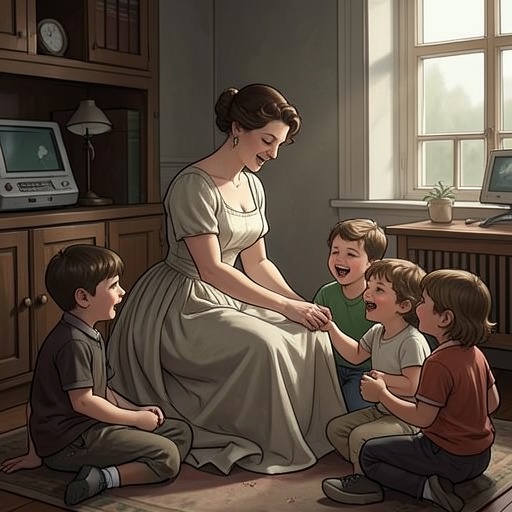
A Woman of SubstanceEmma Harte’s unmarried motherhood is shaped by a collision between class inequality, legal exposure, and the need to provide for a child without surrendering her own means of survival. After Edwin Fairley refuses to marry her, Emma gives birth to Edwina and makes the painful decision to place her with a cousin while she works. The separation does not diminish her sense of responsibility: it redirects that responsibility into a promise to build the security and future she cannot yet provide in person.
Pregnancy and refusal
Emma’s decision to tell Edwin Fairley about the pregnancy follows a moment of intimacy in which she has already declared her love for him. She blurts out that she is going to have a baby, then watches his face change from disbelief to horror. His response makes plain that the pregnancy is not simply a private crisis between two young people: their unequal positions determine what each stands to lose.
Edwin considers marriage, including elopement to Gretna Green, but stops short of speaking. He fears his father’s anger and the loss of the support on which his future at Cambridge and his intended career as a barrister depend. He also judges Emma through the class boundary between a servant and the gentry, deciding that their difference in status cannot be bridged. Emma recognizes his refusal in his silence. Her cutting reference to the impropriety of a marriage between the gentry and the working class turns his unspoken calculation into an explicit indictment of the social order that gives him options and leaves her to bear the consequences.
Birth and the decision to separate
Emma gives birth to a girl at St Mary’s Hospital at Hill Top after ten hours of labour, one month to the day before her seventeenth birthday. Four days later, she studies her sleeping daughter in the makeshift cot Laura O’Neill has fashioned from a drawer, with blankets and pillows for bedding. The intimate scene sharpens rather than resolves the practical dilemma: Emma feels a fierce protectiveness and promises that Edwina will have the best money can buy, but she knows she cannot keep the child with her while earning a living at the mill.
Emma rejects both adoption and an orphanage. After several sleepless nights, she settles on taking Edwina to her cousin Freda in Ripon. Freda has not yet agreed, because Emma has been afraid to write and risk a refusal; Emma nevertheless believes her cousin will take the baby when confronted with the request in person. She plans to pay Freda for the care and to stay with them before returning to work. The arrangement is presented as an act of necessity, not indifference: Emma expects to miss her daughter and intends to visit once or twice each month, then bring her back when she is on her feet.
Registration, secrecy, and protection
The birth certificate creates a further problem. Blackie O’Neill points out that Emma must register the birth in Leeds and provide the father’s name. She refuses to name Edwin Fairley. Faced with the choice between identifying the real father and having the certificate say that the father is unknown, she is offered a third option: Blackie proposes that his own name be entered. He recognizes that this will not remove Edwina’s illegitimate status, but believes a named father will look better than no father recorded. Emma hesitates; Blackie insists that the decision is settled and offers to accompany her to the registrar.
His gesture provides practical and emotional support without changing the facts of Edwina’s birth. The law’s demand for a father’s name makes the absent man a compulsory presence in the record, while Emma has to protect both her child and the secret of Edwin’s identity. Blackie’s proposed entry gives the child a recorded name but leaves the underlying vulnerability intact. Emma’s situation thus turns legal procedure into a personal strategy: she cannot alter the social judgment attached to her daughter’s birth, but she can try to prevent that judgment from being sharpened by the label of an unknown father.
Work as provision and separation
Emma’s promise to secure Edwina’s future becomes the organizing principle of her work. She earns wages as a weaver and, at night, makes and sews clothes for customers Laura has directed to her. On Sundays she prepares pies, pastries, cakes, and other food for local customers, later preserving produce and making pickles, chutneys, relishes, and jams for sale. She lives on her mill wage and reinvests the money from sewing and catering in the business she hopes to build. The work is relentless, but it is also how she converts maternal obligation into a concrete plan for financial independence.
For a whole year after learning of her father’s death, Emma takes no time off except for a monthly visit to Edwina. She regrets that she cannot travel to Ripon more often, and steadies herself against guilt by recalling that the work is for her daughter’s future. The visits and the labor stand in tension: the very effort meant to make reunion and security possible keeps Emma away from the child she longs to raise. Her earlier experience of excessive domestic labor at Fairley Hall also informs her drive to organize work rather than merely endure it. When she is overwhelmed by duties, she times each task, lists the weekly chores, and distributes heavier jobs across the week. That habit of planning reappears in her business life as a means of controlling the pressures that constrained her choices as a young mother.
Marriage, household, and the changing conditions of care
Emma’s circumstances change when she marries Joe Lowther. She tells him that Edwina is illegitimate but withholds the father’s identity, repeating the explanation she had previously given Blackie. Joe accepts the disclosure and says her past does not matter to him. Emma is candid about her child’s status, yet still protects Edwin Fairley’s identity; motherhood therefore remains entangled with concealment even after marriage.
The household Emma later shares with Joe offers a different practical basis for caring for children. Its size and her insistence that she continue to run her business lead Joe to agree to employ staff: a housekeeper-cook, a daily cleaner, and Clara, who first serves as Edwina’s nursemaid and later cares for Christopher. Emma experiences the secluded house as a source of security after Gerald Fairley’s earlier violent intrusion, while the staff make it possible for her to maintain her business and manage family life. The contrast with her first months as a mother is decisive: she had initially had no one available to care for Edwina during the working day, whereas later household resources distribute some of the labor that had once forced separation.
Unmarried motherhood does not end with a single solution. It begins in the rejection of marriage, continues through separation, work, visits, and guarded explanations, and changes as Emma acquires a household and greater resources. Even later, when Emma secures a divorce from Arthur Ainsley for ten thousand pounds, the contrast underscores how differently she can negotiate marital terms once money gives her leverage. Her early experience makes the central cost unmistakable: a mother’s devotion alone cannot overcome the demands of work, class, law, and poverty, so Emma turns ambition into a form of provision for the daughter she cannot initially keep beside her.